
To bell hooks–A Love Letter

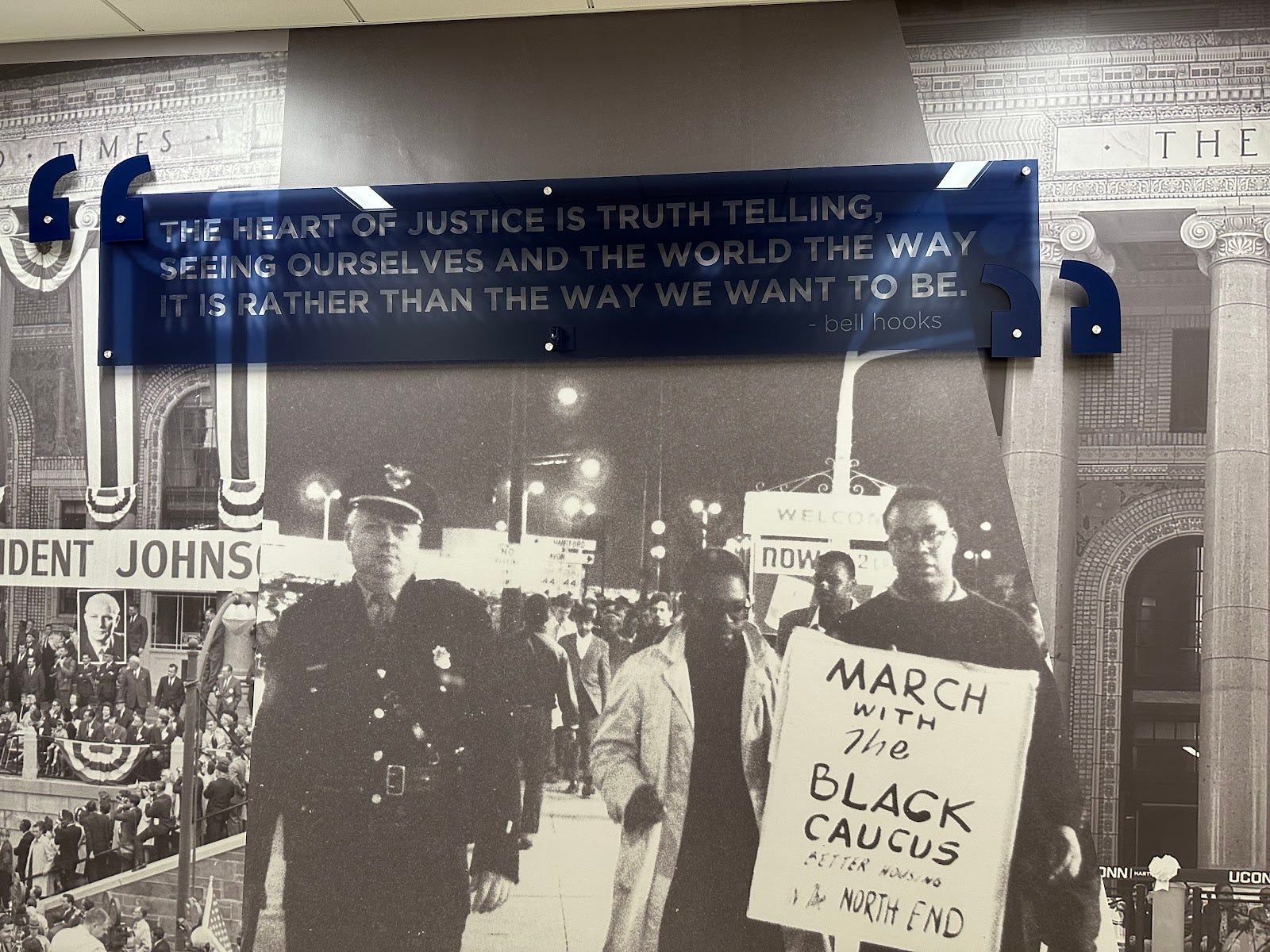
Have you ever found yourself lost in thought from a word, phrase, or statement? Perhaps a quote that found a way to collide with your world? Recently, I found myself at this very point. While attending a class at a local university, I encountered a powerful quote etched in blue glass with transparent letters. The quote was posted overhead in a well-traveled hallway; across from the restrooms and water fill station. It read: 'The heart of justice is truth telling, seeing ourselves and the world the way it is rather than the way we want it to be” (hooks, 2000, p. 33).
As classmates walked by, I found myself lost in a web of these words. From that moment on, I, like the words of Nick Carraway's father in The Great Gatsby, found these words turning over in my mind. Truth-telling. Justice. The world as it is versus the world as we wish it to be. bell hooks’ words had the ability to transform both time and space for me in that moment. But why? What was it about these words that connected with my sociocultural being? To describe my being in such a way is to think about the aspects of my identity (language, ways of thinking, beliefs, value, race, shared attitudes, and customs) that contribute to the manner in which I interpret the world; in other words, I felt a cultural connection (Fletcher, 2022). Little did I know that this quote would serve as universal support of my spiritual journey into care and affirmation as the foundations of love which should be seen in all aspects of our profession; especially with our students.
As a Black male educator focused on literacy and leadership, I approach the world with a deep commitment to justice, truth, and equity, shaped by experiences as a student and an educator. My work is grounded in the belief that sociocultural inclusion begins with honest reflection; about ourselves, our systems, and the students we serve. As someone who values culturally relevant pedagogy and critical inquiry, I view education as a means to empower individuals and communities, particularly those historically marginalized. This has informed my leadership, pushing me to center truth-telling, amplify diverse voices, and create spaces where students and educators alike can see the world as it is, while collectively striving for what it can become.
It struck me how often the pursuit of justice requires an uncomfortable reckoning, a willingness to face hard truths about ourselves and the systems we inhabit. These words felt heavy, as if they were not just etched into glass but into my very consciousness, asking me to look deeper, to confront, to reflect.
What does it mean to truly see the world as it is? In the opening of Ta-Nehisi Coates (2015) Between the World and Me he was forced to consider the vast gap between his interviewer’s world and the one he was brought in to speak about which could not be closed by satellite. The world that his grandparents told him he would have to find “some way to live within the all of it” (p. 11-12). This is the same world that James Baldwin (1962) described as the cause of his brother’s invisible tears that no one’s hand could wipe away and how he has narrowly survived it. Worlds that bring pain, physical or invisible tears, barriers and uncertainty are managed by the resilience of our humanity. Baldwin’s words reveal that “we are capable of bearing a great burden, once we discover that the burden is reality and arrive where reality is” (p.91). So how do we reconcile the collision of worlds, reality, and learning in our various school settings and classrooms?
To hold up a mirror not only to ourselves but to the societal constructs we often navigate unquestioningly is an act of courage, I think, that strips away the filters we place on reality, especially the biases, the aspirations, the stories we tell ourselves to avoid the discomfort of truth. And all too often we, as educators, avoid these discomforts within our classrooms. The place that students should have the space to safely test ideas with guidance and support while in narratives and informational texts. To expose the truth of their reality and learn within the diverse tapestry of individuals in their class, grade level, or school building. And yet, isn’t this where justice begins? Not in the comfort of the familiar, but in the disruption of it?
It is amazing that one quote would flood my mind with all of these thoughts. The infinite historical references, previously read texts, and lived experiences wrapped in a moment—a sentence. I couldn’t help but wonder: what truths have I avoided because they didn’t align with the world I wanted to see? What narratives have I clung to because they made the weight of injustice easier to bear? These words stayed with me like an echo, challenging me to step into the vulnerability of truth-telling, not just as an individual, but as an educator.
My journey to locate the book that held the quote which collided with my world sent me on an expedition of love. It would not be until much later that I would locate it in bell hooks (2000) All About Love. Originally, I turned to my favorite research assistant, ChatGPT, to help me locate the source of the quote. With confidence it assured me that it was in bell hooks (2003) Teaching Community: A Pedagogy of Hope. It was here that I quickly learned that I was destined to encounter this text first.
A pedagogy of hope is a concept that empowers us to continue our work for justice even as the forces of injustice may gain greater power for a time (hooks, 2003). More than two decades ago hooks suggests that one of the dangers we face is a loss of community in our educational system, not just with the ones we work closely with, but also a loss of a feeling of connection and closeness with the world beyond our educational silos. She continues that a pedagogy of hope is based in progressive education which enables us to confront feelings of loss and restore our sense of connection. Moreover, it teaches us how to create community. To that end, teachers and administrators must consider the role of love within the creation of community.
Love is such a challenging concept, idea, or emotion to capture. Mainly due to, as hooks (2000) explains, our lack of a shared working definition of love. In the actual book which held the quote which collided with my world, hooks uses the opening chapter to elaborate on the various definitions of love that exist before landing on a definition from M. Scott Peck–love is “the will to extend one’s self for the purpose of nurturing one’s own or another’s spiritual growth.” In this, love moves beyond a state of eternal happiness due to receiving an item or care. It promotes growth of the individual and of others. It solidifies the idea that justice and truth telling involves love.
Baldwin (1962) asserts love takes off the masks that we fear we cannot live without and know we cannot live within. [He used] the word “love” here not merely in the personal sense but as a state of being, or a state of grace–not in the infantile American sense of being made happy but in the tough and universal sense of quest and daring and growth (p. 95). Both Baldwin and hooks support an overlapping concept of love as the want for self-growth or the promotion of growth in another. In a pedagogy of hope, this can be suggested as teachers believing that learning is possible, that nothing can keep an open mind from seeking after knowledge and finding a way to know (hooks, 2003). Freire (1985) connects the application of love in the classroom through the “ability to love students in spite of everything…a love for students which pushes us to go beyond, which makes us more and more responsible for our task” (p.16). And our task is the individual, spiritual growth of our students.
As I continue my journey and spiritual growth in literacy and educational leadership, I realize that it, after all, is about more than decisions and policies; it’s about integrity. It’s about holding space for honesty, even when that honesty exposes fractures we would rather ignore. In this, the initial bell hooks’ quote reminded me that justice is not a destination but a process—a practice of continually seeking truth, no matter how messy or inconvenient it might be.
And so, as I stood in that hallway, watching the ebb and flow of my peers, I realized that these words were not just a call to reflection but a call to action. To see the world as it is and still hold hope for what it can become. To acknowledge education as an act of love that can move us beyond the challenges we face. To speak truth, not just when it’s easy, but especially when it’s not. Perhaps this is the heart of justice: not perfection, but persistence. Not the absence of struggle, but the presence of love, honesty, and an unrelenting commitment to seeing clearly. Thank you bell hooks, for having the will to extend yourself to my spiritual growth. I can only hope to continue this within myself and contribute to the growth of others.
References
Baldwin, J. (1991). The fire next time. New York: Vintage.
Coates, T. (2015). Between the world and me. New York: Spiegel & Grau.
Fletcher, K. (2022). Fostering a social and cultural literacy classroom through an administrator-teacher relationship [Doctoral dissertation, University of South Carolina]. ProQuest.
Freire, P. (1985). Reading the world and reading the word: An interview with Paulo Freire. Language Arts, 62(1), 15-21.
hooks, b. (2000). All about love: New visions. New York: William Morrow.
hooks, b. (2003). Teaching community: A pedagogy of hope. New York: Routledge.