Short Reads Between Worlds #7
When Reading Has No Purpose

In previous Short Reads, we explored how microteaching and metacognition create the conditions for students to internalize reading strategies and monitor their thinking, allowing learning to transfer beyond the lesson. We then examined how summarization, when treated as a process rather than a product, helps students synthesize ideas over time and build meaning across a text. Most recently, we positioned independent reading as a protected space for practice, where students apply these strategies with support and move along a continuum toward deeper engagement and identity as readers. Across these moves, a common thread emerges: reading is not about completing tasks, but about creating opportunities for meaning-making.
This raises an essential question: what drives that process?
The answer begins with purpose, and purpose begins with questioning.
📌 The Challenge
When comprehension strategies turn into routines, reading practice becomes an act of compliance.
We know that the purpose of reading is to understand a text—both at the literal and inferential levels. In other words, reading is thinking. Reading is meaning-making. Reading is engaging with a text for a purpose.
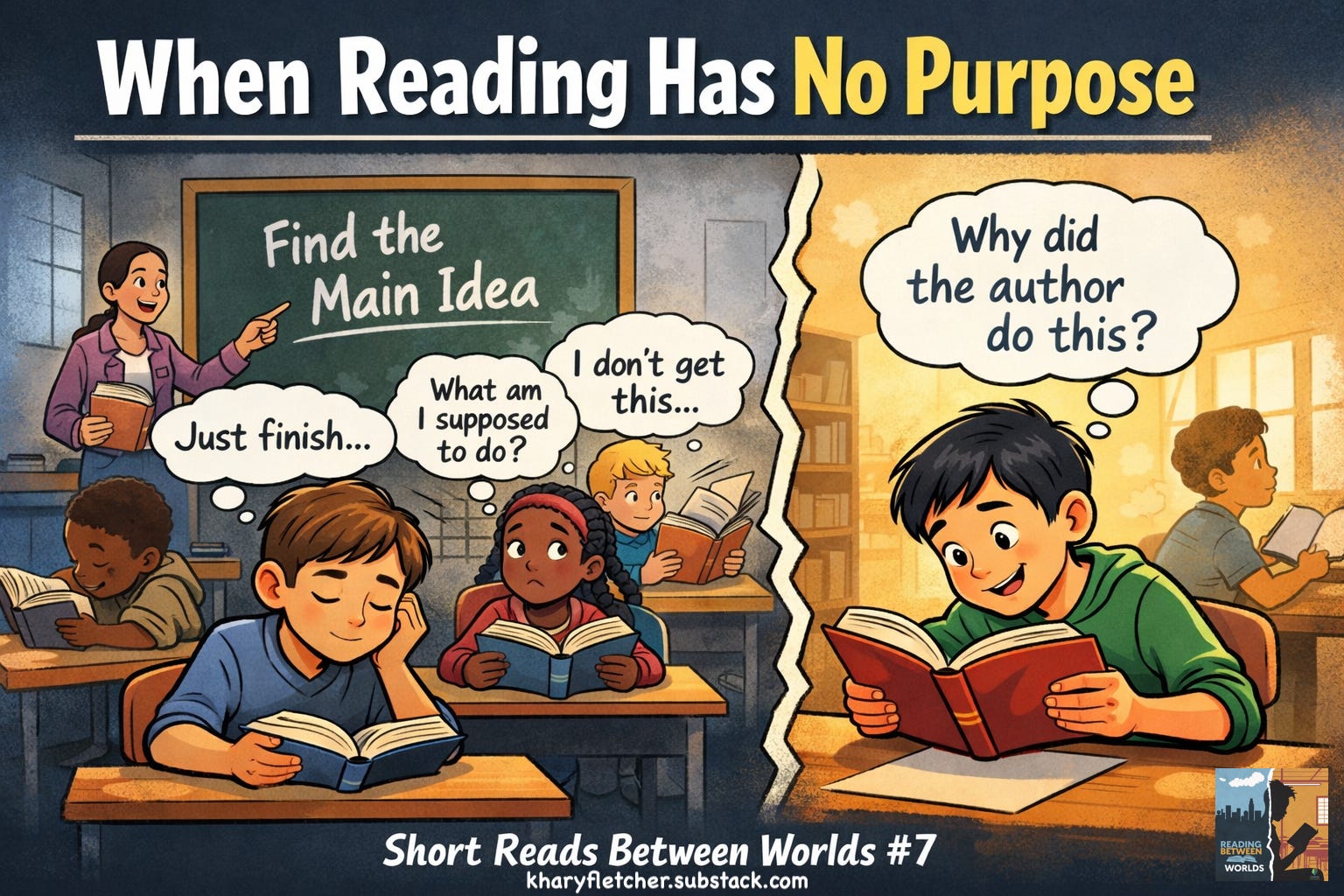
Yet, in many classrooms, comprehension strategies are reduced to tasks in the minds of our students.
Students are asked to:
find the main idea
make an inference
answer questions
But too often, these are treated as isolated skills. They are completed for the sake of completion rather than in service of understanding.
When this happens, the work of reading shifts.
Instead of constructing meaning, students are performing strategies. Instead of thinking, they are complying.
This is the difference between comprehension strategy instruction and isolated skill instruction in practice.
🔍 The Opportunity
Without meaning-making, comprehension strategies become empty routines.
Comprehension strategies represent the ongoing processes that proficient readers use to make sense of text. They are habits of thinking—automatic, recursive, and purposeful.
Isolated skill instruction, on the other hand, removes these strategies from their intended context. Students practice the skill, but not the reason for using it. The result is predictable:
Students can complete the task…
but they cannot always explain what the text means or why it matters.
Without a clear purpose for reading, strategies lose their power. They become routines. And reading becomes something to get through rather than something to figure out.
This is where the problem becomes clear:
If reading is an invisible process (one that requires readers to connect ideas, monitor understanding, and build meaning) then simply assigning strategies is not enough.
Students need more than directions. They need a reason to think deeply about the text.
🎯 The Move in Action
Use questioning to establish purpose for reading and drive students’ engagement with text.
If we want students to move beyond compliance, we must move beyond assigning strategies and position questions as the driver of reading.
Research has consistently shown that questioning supports comprehension. The National Reading Panel (2000) identified asking and answering questions as a key practice for improving understanding. Hattie (2009) further reinforces this, showing that questioning and self-questioning are high-impact moves that support students in monitoring their thinking and constructing meaning.
Hattie found that the average effect size across interventions was 0.40 and used this as a benchmark to determine which instructional practices truly make a difference in student learning.
Questioning effect size ≈ 0.48 (positive impact)
Self-questioning ≈ 0.64 (high-impact)
But the shift that matters most happens when questioning moves from the teacher to the student.
Pearson, Roehler, Dole, and Duffy (1992) explain that when students generate their own questions, especially higher-order questions, they engage in deeper levels of text processing. Studies by Singer and Donlan (1982) and Palincsar and Brown (1984) show that students who generate questions outperform those who simply respond to teacher-created prompts. The difference is not in the strategy. It is in the ownership of thinking.
This is where our instructional moves matter.
During mini-lessons, we model how questions guide our thinking:
What is happening here?
What is the author suggesting or doing in this section?
Why does this matter?
But we do not stop there.
We use these moments to position questioning as something students carry into their protected time for independent reading.
During independent reading, questions become the anchor for engagement:
Teacher-directed questions establish a clear purpose for reading,
Student-generated questions sustain thinking and deepen understanding.
In this way, authentic student questioning connects the work of the lesson to the work of the reader.
Over time, these questions do more than support comprehension.
They begin to shape how students understand:
the text
themselves
others
the world around them
Questioning is not something we do after reading.
It is how reading happens.
🗨️Now It’s Your Turn
The right questions can serve as a launch into explicit, whole-group instruction and a bridge into independent practice.
As you plan your next lesson, consider this:
What question will give your students a reason to read?
This question can anchor whole-group instruction and carry into one-to-one and small-group reading conferences. Let’s ensure that students are not just completing tasks, but actively making meaning.
Until next time…
Keep the fire lit. Teach with love. Read with purpose.
Reference
Hattie, J. (2009). Visible learning: A synthesis of over 800 meta-analyses relating to achievement. Routledge.
National Reading Panel. (2000). Teaching children to read: An evidence-based assessment of the scientific research literature on reading and its implications for reading instruction (NIH Publication No. 00-4769). U.S. Department of Health and Human Services, National Institute of Child Health and Human Development. https://www.nichd.nih.gov/publications/pubs/nrp/Documents/report.pdf
Pearson, P. D., Roehler, L. R., Dole, J. A., & Duffy, G. G. (1992). Developing expertise in reading comprehension. In S. J. Samuels & A. E. Farstrup (Eds.), What research has to say about reading instruction (2nd ed., pp. 145–199). International Reading Association.