
#2 – Making Thinking Visible Across Classrooms
Viewing Literacy Learning Beyond “Engagement”


📌 The Challenge
Leaders can’t support instruction if they can’t see how teachers make student thinking visible.
During classroom visits, instructional leaders often look for “student engagement.” But engagement is slippery. It might look like quiet compliance or active participation, and neither tells us much about whether students are thinking. Evaluation rubrics and instructional guides push us to look for more than busy work. They call for students actively reading, writing, and discussing texts. Yet, too often, walkthroughs focus on what the teacher is doing rather than what students are thinking and showing. So the real challenge is this: how can leaders (coaches and administrators) see evidence of student thinking in literacy classrooms?
🔍 The Opportunity
Classroom visits focused on routines (KNOW Charts, Think-Alouds, Stop & Jots, Think-Pair-Share) reveal how well classrooms uncover invisible processes.
Making student thinking visible is about more than watching for raised hands. Literacy classrooms provide multiple entry points—student talk, quick writes, annotations, sketches, graphic organizers, models, or problem-solving steps—all of which show how learners are processing texts. Frameworks like Danielson’s Domain 3, Connecticut Common Core of Teaching Domain 3b, or Marzano’s Domain 1 explicitly guide leaders to look for these forms of evidence. And Learning Forward’s Standards for Professional Learning remind us that leaders must create professional learning structures where teachers can refine these routines and share student artifacts as evidence of impact. When leaders shift their lens from “Are students engaged?” to “How is student thinking visible here?”, they change the feedback conversation from surface-level to instructional depth.
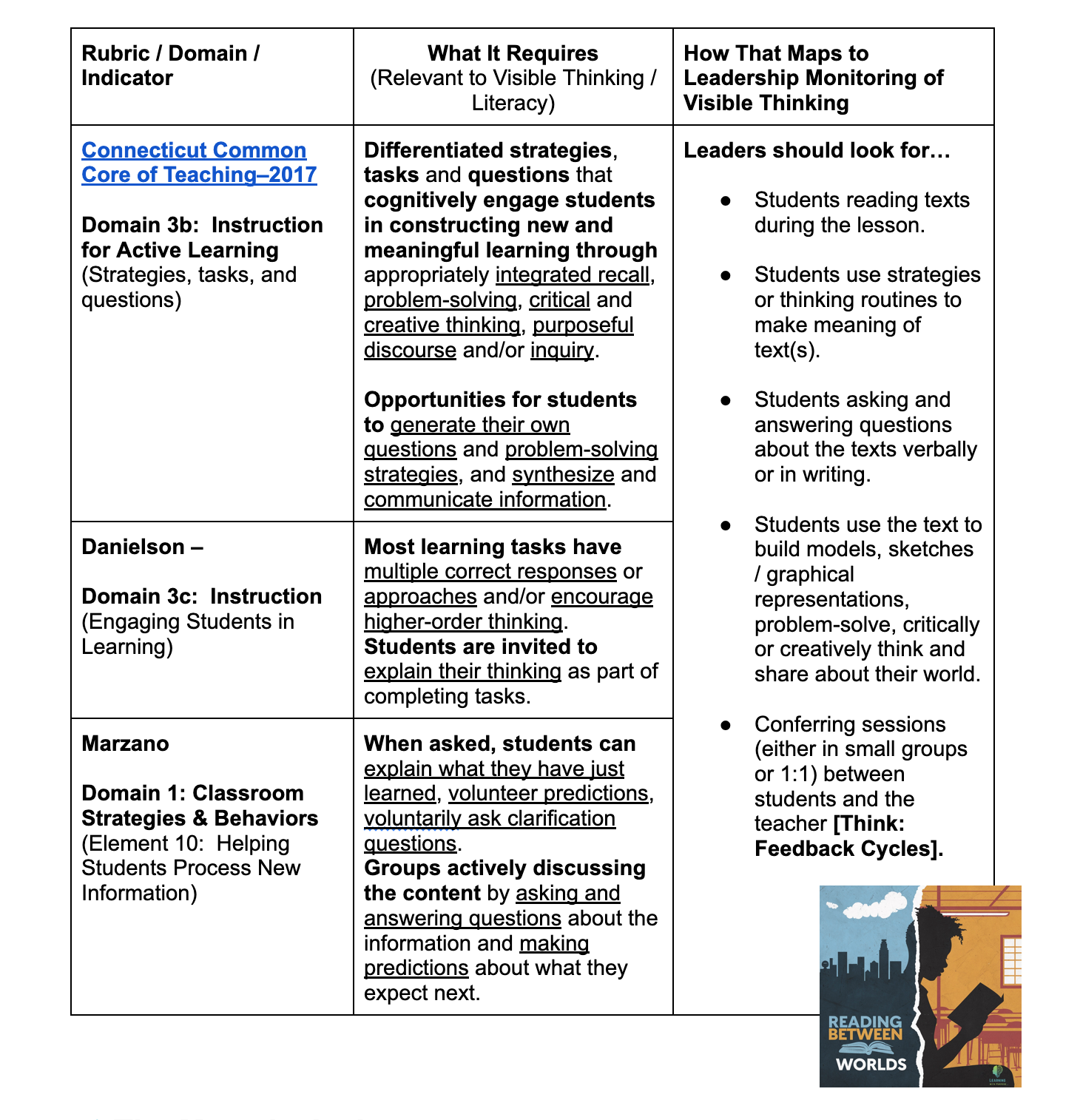
🎯 The Move in Action
Don’t just observe teaching—look for thinking.
The next time you step into a classroom looking for literacy practices:
Look for evidence, not activity. Do you see students reading and speaking about text, writing to make meaning, or representing ideas through sketches or models?
Record patterns across classrooms. Track what percentage of students’ thinking is surfaced through discourse, writing, or representations—not just what the teacher is presenting.
Close the loop with professional learning. Use these observations to design collaborative teacher learning (e.g., team or faculty meetings where teachers bring student annotations, quick writes, or discussion transcripts to analyze). This aligns directly with Learning Forward’s Leadership and Data standards [leaders build systems where student thinking guides teacher growth].
When leaders anchor walkthroughs in visible student thinking, literacy becomes more than a performance of engagement. It becomes a record of reasoning.
🗨️Now It’s Your Turn
When you walk into a classroom, what specific evidence of student thinking (speaking, writing, sketching, problem-solving) are you looking for?
How can you use what you see in classrooms to shape professional learning that helps teachers make student thinking more visible?
Comment below and let’s create a community of teachers and leaders focused on promoting great practices.
Until next time..
Keep the fire lit. Teach with love. Read with purpose.
Reference
Connecticut State Department of Education. (2017). CCT rubric for effective teaching 2017. https://portal.ct.gov/-/media/SDE/Evaluation-and-Support/CCTRubricForEffectiveTeaching2017.pdf
Danielson, C. (2013). The framework for teaching: Evaluation instrument (2013 ed.). The Danielson Group. https://www.nysed.gov/sites/default/files/danielson-teacher-rubric-2013-instructionally-focused.pdf
Learning Forward. (n.d.). Standards for professional learning. Retrieved September 27, 2025, from https://standards.learningforward.org/
Marzano, R. J. (2012). Marzano teacher evaluation model. Marzano Resources / Washington Office of Superintendent of Public Instruction. https://ospi.k12.wa.us/sites/default/files/2023-10/marzano_teacher_evaluation_model.pdf